In the past twelve months, 88.4% of organizations experienced at least one AI agent-related security breach, with data leakage (50.1%) and manipulation by untrusted inputs (49.6%) as the most common incident types (source: AvePoint State of AI 2026).
B2B Centr tracks how software categories form, split, and get sold, and few have fragmented as fast or as confusingly as AI risk.
Vendors market "AI protection," "AI security," and "AI safety" as interchangeable, but they solve different problems, sit in different budgets, and answer to different regulators.
Get the distinction wrong and you buy a guardrail product to stop a prompt injection, or hire a red teamer to fix a bias complaint.
This guide explains what each term means, where they overlap, how they map to regulation and job roles, and how to cover all three without paying twice for the same control.
Key Takeaways
- AI security protects AI systems from attackers, data theft, and adversarial manipulation.
- AI safety prevents AI systems from causing harm through their own behavior.
- AI protection spans deepfake, identity, fraud, brand, and content protection.
- Only 8% of organizations globally have a comprehensive AI governance framework today.
- Mature AI governance programs report 45% fewer security incidents than unstructured ones.
The Three-Budget Split: How the AI Risk Market Actually Divides
The clearest way to separate these three terms is to follow the money, because each funds a different line item.
AI security is the largest of the three.
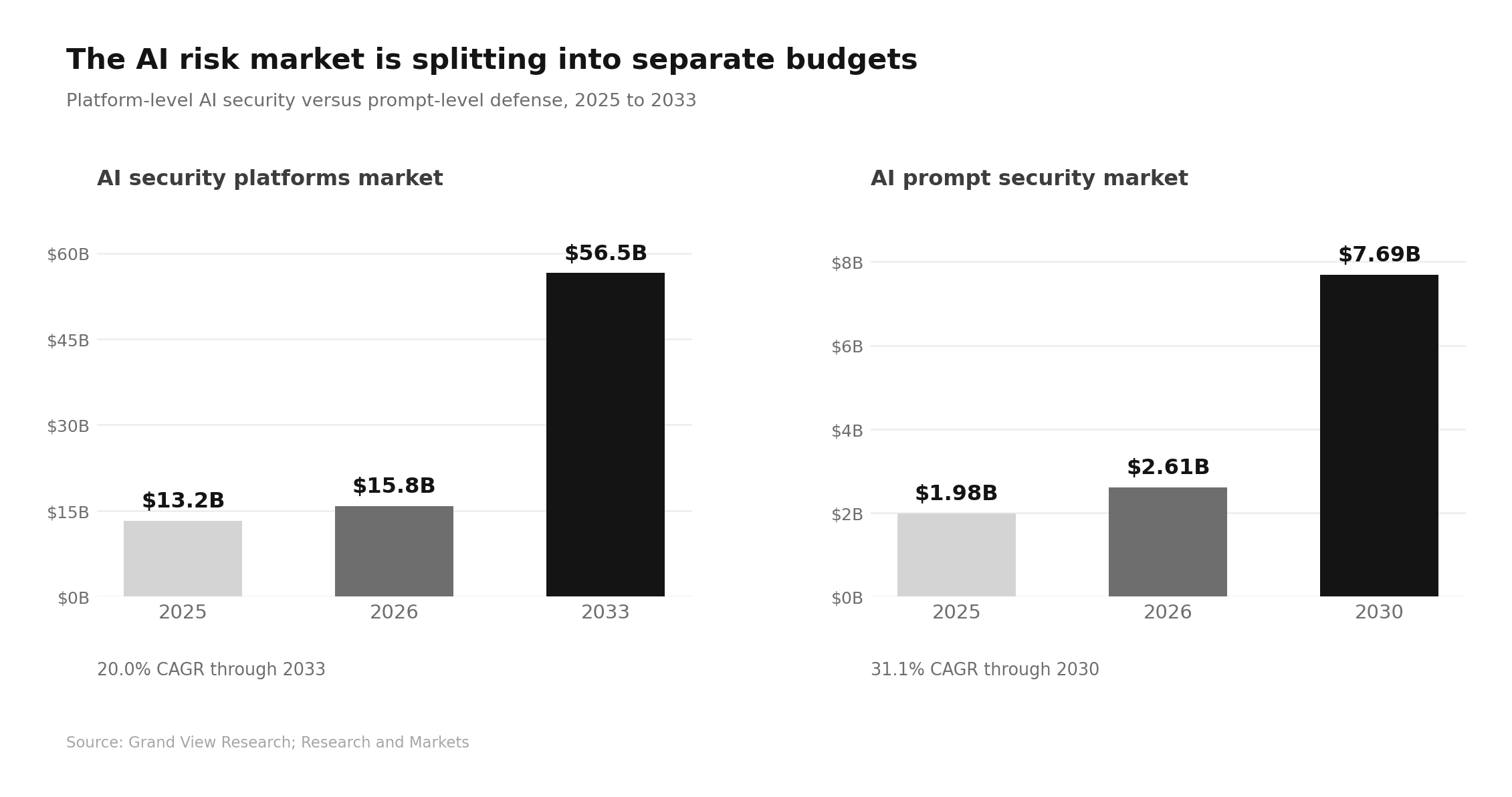
The AI security platforms market was valued at $13.2 billion in 2025 and is estimated at $15.8 billion for 2026, on track for $56.5 billion by 2033 at a 20.0% CAGR (source: Grand View Research).
Its narrowest slice, prompt-level defense, grows fastest: the AI prompt security market sits at $2.61 billion in 2026 and is projected to hit $7.69 billion by 2030 at a 31.1% CAGR (source: Research and Markets).
AI safety and governance budgets are smaller and increasingly compliance-driven rather than threat-driven.
AI protection, meaning defense against AI-generated attacks aimed at humans, is the newest and is funded out of fraud, trust and safety, and brand budgets.
Generative AI-enabled fraud surged 1,210% in 2025, and US losses from AI-facilitated fraud are forecast to reach $40 billion by 2027, up from $12.3 billion in 2023 (source: Vectra AI and Javelin analysis).
Three markets, three growth curves, three buyers. That is why the terminology matters.
Why the Vocabulary Confusion Is Expensive
Most enterprises do not have a naming problem. They have a coverage problem that a naming problem hides.
Only 8% of organizations globally have a comprehensive AI governance framework, dropping to 2% among small firms, while 88% actively use AI across business functions (source: Economist Impact via Evolvance).
That gap is where risk accumulates. Documented AI incidents reached 362 in 2025, up from 233 a year earlier, a 55% rise, while governance roles grew only 17% (source: Stanford HAI 2026 AI Index).
Visibility compounds it. The average enterprise now operates 3,891 SaaS and AI environments and 139 or more AI-enabled SaaS applications, with AI-related SaaS attacks up roughly 490% year over year (source: Security Boulevard).
What you cannot inventory, you cannot secure, govern, or defend against. The same dynamic drives shadow AI adoption inside companies.
The payoff is measurable: enterprises with mature AI governance report 45% fewer security incidents and resolve breaches 70 days faster than those with no formal oversight (source: Practical DevSecOps).
What Is AI Security?
AI security protects:
- AI systems, their models, their data, and their infrastructure from attackers.
The threat actor is external and adversarial. The question it answers is: can someone break, steal, poison, or hijack our AI?
What it covers:
- Prompt injection and jailbreaking: Now the top vulnerability on the OWASP Top 10 for LLM Applications, with NIST reporting a rise of more than 2,000% in AI-specific CVEs since 2022 (source: Practical DevSecOps). See this breakdown of prompt injection, permissions, and the blast radius problem.
- AI model protection: Defending weights and training data against theft, extraction, and poisoning, including attackers querying an API to reconstruct proprietary models.
- AI threat protection: Runtime detection of adversarial inputs, anomalous tool calls, and exfiltration attempts across the inference path.
- AI endpoint protection: Securing the devices, browsers, and agent runtimes where models are actually invoked, which is where most shadow usage originates.
- Supply chain risk: Compromised model weights, malicious packages, and unvetted third-party inference providers.
- Identity and access sprawl: Two-thirds of enterprises contain risky OAuth permission scopes, and governance failures increasingly originate from access sprawl rather than model misuse alone (source: Security Boulevard).
Who owns it: the CISO organization. Controls sit alongside your existing stack, so most teams fold this into an existing cybersecurity stack rather than standing up a separate function.
Mid-market buyers can review the landscape of enterprise AI security platforms.
What Is AI Safety?
AI safety prevents an AI system from causing harm through its own behavior, even when nobody is attacking it. There is no adversary. The question it answers is: will our AI do something harmful or wrong on its own?
What it covers:
- Alignment and behavioral control: Ensuring model outputs match intended goals and stated policies.
- Hallucination and reliability: Confident, incorrect outputs in high-stakes workflows like underwriting, clinical triage, and hiring screens.
- Bias and fairness: Disparate outcomes across protected groups, increasingly a regulated concern.
- Autonomy limits: Constraining what an agent may do without human approval.
- Evaluation and red teaming: Structured pre-deployment testing. Review how to test an agent before it touches customers before any production launch.
Who owns it: a responsible AI, model risk, or AI governance function, usually reporting into legal, risk, or the Chief AI Officer rather than security.
Most teams start from an AI ethics or responsible AI framework.
What Is AI Protection?
AI protection is the newest and least standardized of the three. It refers to protecting people, brands, and assets from harm caused by AI systems operated by someone else.
AI is the weapon, not the asset being defended. The question it answers is: how do we defend against AI being used against us and our customers?
The term is broad, so it helps to break it into the five sub-categories buyers actually purchase against:
- AI deepfake protection: Detecting synthetic video, audio, and documents. Deepfakes now account for one in five biometric fraud attempts, with injection attacks up 40% year over year (source: Entrust 2026 Identity Fraud Report).
- AI fraud protection: Stopping AI-generated scams at the transaction layer. The FBI's Internet Crime Complaint Center logged 22,364 complaints referencing AI and $893.35 million in adjusted losses in 2025, its first year tracking AI as its own category (source: FBI IC3 2025 Annual Report via Memeburn).
- AI identity protection: Verifying that a human on a call, video, or KYC flow is who they claim to be, rather than a cloned voice or face.
- AI brand protection: Monitoring for executive and brand impersonation. Celebrity and government impersonation deepfakes endorsing fraudulent investments accounted for $1.13 billion, or 52%, of all deepfake fraud losses (source: Surfshark Deepfake Fraud Study).
- AI content protection: Provenance, watermarking, and disclosure, so you can prove what your organization did and did not publish.
Who owns it: fraud, trust and safety, brand, and communications teams, with security supporting.
In agentic commerce this bleeds into transaction risk, which is why agentic payment security risks are a board-level topic.
Side-by-Side: The Core Differences at a Glance
| Dimension | AI Security | AI Safety | AI Protection |
|---|---|---|---|
| Core question | Can our AI be attacked? | Will our AI cause harm? | Can AI be used against us? |
| Threat source | External attacker | The system itself | Third-party AI operators |
| Primary asset | Models, data, infrastructure | Users and decision quality | People, brand, customers |
| Typical owner | CISO / security engineering | Responsible AI / risk / legal | Fraud, trust and safety, brand |
| Example failure | Prompt injection exfiltrates a database | Model denies loans on protected traits | Cloned CFO voice authorizes a wire |
| Core controls | Access control, input filtering, monitoring | Evals, guardrails, human oversight | Detection, verification, provenance |
| Regulatory anchor | NIST, ISO 27001, SOC 2 | EU AI Act, NIST AI RMF, ISO 42001 | Fraud, consumer protection, disclosure |
| Buying trigger | Model in production | Model makes consequential decisions | Brand or customers are targeted |
Where the Three Overlap, and Where Teams Get It Wrong
The clean table above breaks down at three specific seams, and this is where most programs fail.
Seam one: agentic systems. An AI agent with tool access collapses security and safety into one problem. A prompt injection (security failure) causes an agent to take an unauthorized action (safety failure) that drains an account (protection failure).
One root cause, three response teams, and usually no single owner. Any organization deploying agents should work through an autonomous agent readiness checklist before granting production permissions.
Seam two: AI data protection. Training data quality is a safety issue. Training data access is a security issue. Training data lawfulness is an AI privacy protection issue.
All three depend on the same data lineage work, which is why data privacy in AI systems sits underneath every AI risk program. It is also where employee-pasted confidential data quietly becomes someone else's training corpus.
Seam three: monitoring. One runtime telemetry stream, prompts in, outputs out, tools called, detects attacks, unsafe behavior, and abuse patterns alike.
Teams building three separate monitoring stacks pay three times for one capability.
The most common structural mistake is assigning all three to the CISO. Security teams excel at adversarial threat modeling and are poorly positioned to adjudicate whether a hiring model is fair.
The second mistake is the reverse: burying AI security inside a governance committee that meets monthly while attackers move hourly.
How Each Maps to Regulation in 2026
Regulatory alignment is the fastest way to settle internal ownership debates, because the law names the obligation.
The EU AI Act is the anchor.
On 16 June 2026, the European Parliament approved Digital Omnibus amendments by a vote of 423 to 57, pushing most high-risk obligations out to December 2027 for standalone Annex III systems and August 2028 for product-embedded systems (source: Digital Applied).
Article 50 transparency duties, covering chatbot disclosure, AI content marking, and deepfake labeling, were not delayed and took effect on 2 August 2026, with maximum fines of €35 million or 7% of global turnover (source: Legiscope).
That split is instructive. Article 50 is an AI content protection provision: it exists to stop people being deceived by synthetic media.
The deferred high-risk regime, covering risk management, data governance, logging, and human oversight, is an AI safety regime, and it runs concurrently with GDPR on the AI privacy protection side.
Neither is an AI security mandate, which continues to be governed by NIST, ISO 27001, and sector rules. B2B teams shipping AI-driven outreach should read the specifics of EU AI Act Article 50 obligations for AI SDRs, and regulated-industry teams can start from an AI governance checklist.
Who Owns What: Roles and Salary Benchmarks
Compensation data confirms the three-way split and shows which discipline the market values most.
AI security roles: The average AI security engineer salary in the United States is $152,773 as of August 2026, with 90th-percentile earners at $205,000 (source: ZipRecruiter).
Total comp at specialist firms runs higher: $150,000 to $220,000 junior, and $220,000 to $320,000 mid-level for engineers shipping LLM red team programs (source: infosec.qa).
Certified AI security roles command a 6% to 17% premium, with AI security managers at $145,000 to $185,000 (source: ACBM).
AI safety and governance roles: Directors of AI Governance sit at $190,000 to $250,000 and above, Chief AI Officers at $200,000 to $350,000 and above, and Responsible AI Scientists at $180,000 to $221,000 and above (source: Tech Jacks Solutions).
Professionals bridging AI privacy protection and governance earn a US median of $169,700, against $151,800 for AI-only practitioners (source: VerifyWise).
The read: security prices on scarcity and technical depth; governance prices on seniority and regulatory exposure.
Both are converging, and 44% of technology leaders will pay more for verified AI credentials (source: Tech Jacks Solutions).
How to Build a Program That Covers All Three
Use this sequence rather than buying tools first.
- Inventory first: You cannot govern 139 AI-enabled applications you have never listed. Include shadow tools and agents.
- Classify by consequence, not technology: A chatbot answering FAQs and a model denying credit are not the same risk class, even on identical infrastructure.
- Assign one accountable owner per category: Security owns adversarial risk, governance owns behavioral risk, fraud owns external AI abuse. Write it down.
- Instrument once, route three ways: Build one runtime telemetry layer and feed three sets of detections from it.
- Set autonomy tiers for agents: Define what an agent may do unattended, what needs approval, and what is prohibited. Enforce at the permission layer, not in the prompt.
- Red team all three surfaces: Test for injection (security), harmful or biased output (safety), and brand impersonation (protection).
- Govern without blocking adoption: The failure mode at both extremes is identical: no controls, or controls so heavy teams route around them. See how to build an AI governance framework that does not kill adoption.
What to Ask Vendors Before You Buy
Most vendors use all three terms in marketing and deliver only one.
Five questions cut through it:
- Do you defend the model, govern its behavior, or detect AI used against us? Pick one.
- What is your detection evidence, and against which published benchmark?
- Do you enforce at runtime, or only report after the fact?
- How do you handle tool-using agents with write permissions, not just chat interfaces?
- Which specific regulatory article or control framework does this satisfy?
Vendors that cannot answer the first question without a slide deck are selling category confusion.
The same discipline applies to any modern security stack purchase.

Conclusion
B2B Centr exists to make category boundaries legible before buyers spend against them, and AI risk is the clearest example of three distinct disciplines sold under one label.
AI security defends your AI systems from attackers.
AI safety prevents your AI systems from causing harm on their own.
AI protection defends your people, brand, and customers from AI operated by someone else.
They share infrastructure, telemetry, and data lineage, but they answer different questions, sit in different budgets, report to different owners, and map to different regulations.
Organizations that name the three clearly, assign one accountable owner to each, and instrument once instead of three times close the governance gap most enterprises are still carrying.
The ones that treat all three as a single procurement line keep buying the wrong control for the wrong failure.
Read Next
- 2026 Website Cost Report
- Average Marketing Budget by Industry
- How to Build a Cybersecurity Stack for a Small Business
FAQs
1. What is the difference between AI security and AI safety?
The difference between AI security and AI safety is the source of the threat. AI security protects AI systems from external attackers using techniques like prompt injection, data poisoning, and model theft. AI safety prevents AI systems from causing harm through their own behavior, including hallucinations, bias, and unauthorized autonomous actions, even when no attacker is involved.
2. What is AI protection and how is it different from AI security?
AI protection is the practice of defending people, brands, and customers from AI systems operated by third parties, and it covers AI deepfake protection, AI identity protection, AI fraud protection, AI brand protection, and AI content protection. It differs from AI security because the AI is the weapon rather than the asset defended, and it usually sits with fraud and trust and safety teams rather than the CISO.
3. Which team should own AI security, AI safety, and AI protection in 2026?
The teams that should own AI security, AI safety, and AI protection in 2026 are the CISO organization, the responsible AI or model risk function, and the fraud or trust and safety team respectively. Assigning all three to security is the most common structural mistake, because security teams are built for adversarial threat modeling rather than fairness adjudication.
4. Does the EU AI Act cover AI security, AI safety, or AI protection?
The EU AI Act primarily covers AI safety and AI protection rather than AI security. Its Article 50 transparency duties, live since 2 August 2026, address deepfake labeling and chatbot disclosure, which is AI protection. Its deferred high-risk regime covering risk management, logging, and human oversight is AI safety. Traditional AI security remains governed by NIST, ISO 27001, and sector-specific rules.
5. How much do AI security and AI governance professionals earn in 2026?
AI security and AI governance professionals earn between roughly $145,000 and $350,000 in the United States in 2026, depending on function and seniority. AI security engineers average around $152,773 annually, AI security managers sit at $145,000 to $185,000, Directors of AI Governance range from $190,000 to $250,000 and above, and Chief AI Officers reach $200,000 to $350,000 and above.
Disclaimer: This content is provided for informational purposes only and does not constitute legal, financial, or compliance advice. Protocol versions, governance arrangements, and partner counts cited here reflect publicly announced milestones as of August 2026 and are moving quickly. Adoption figures come from vendor and foundation announcements with differing methodologies and should be treated as directional signals rather than guaranteed outcomes.